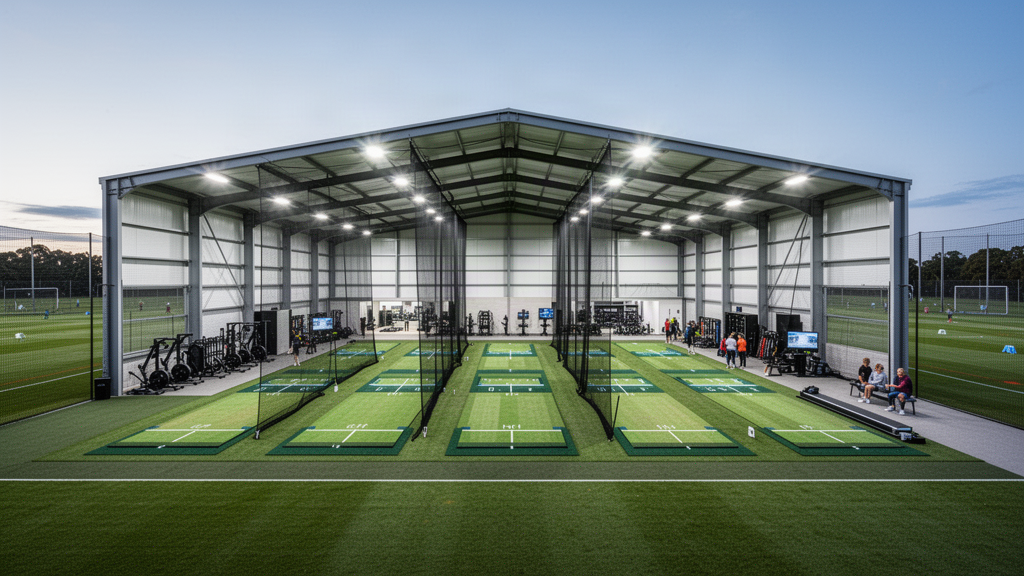
01Separate the cricket pitch from the practice-lane footprint
MCC Law 6 defines the cricket pitch as 22 yards / 20.12 m long and 10 ft / 3.05 m wide. That does not set the overall length or width of a practice cage.
Bowling run-up, batter clearance, rear containment, side net separation, coach positions and safe circulation determine the real practice footprint.
Define the training programme before lane count
Record age groups, bowling pace, batting, wicketkeeping, coaching, simultaneous users, bowling-machine use and whether bowlers need full run-ups. These decisions control lane length, access and total facility size.
A school with junior coaching and an academy training pace bowlers should not be forced into the same generic lane geometry.
Plan single and multi-lane systems around containment and movement
Side, rear and roof netting should be selected around realistic ball trajectories and adjacent users. Entry points, divider overlaps and coach circulation should avoid crossing live bowling or batting zones.
Multi-lane banks introduce shared structure, lighting, drainage and maintenance issues that should be solved as one system rather than by repeating an isolated cage.
Choose surfaces and technology around the training objective
Indoor and outdoor strips may use different surface pathways to create different pace or bounce responses. Base condition, drainage, wear and local maintenance capability still control the final build-up.
Bowling machines, cameras, power and data should be coordinated before the nets and structure are fixed so analysis and machine operation do not create unsafe improvised positions later.
Plan the route from basic nets to a complete training centre
Schools and clubs can start with one or two lanes while protecting space, services and access for additional lanes, cover, indoor conversion, lighting and analysis technology.
Larger academies can combine indoor and outdoor practice, varied surfaces, coaching review, strength and conditioning, equipment storage and player waiting as one complete development environment.