
Apollo NZ Global

Built Intelligence · Sports & Recreation · Sports facilities

Modular Skatepark vs Concrete Skatepark: Choose the Project Model Before the Material

A modular skatepark and a concrete skatepark can serve many of the same riders, but they create very different project pathways. The useful comparison is not whether one material is universally better. It is which delivery model fits the site, budget, programme, community and long-term ownership.

Apollo NZ Global EditorialPublished 2026-10-07Project intelligence
Editorial guidance — final product, engineering, compliance and site requirements are confirmed for the actual project.
Modular Skatepark vs Concrete Skatepark: Choose the Project Model Before the Material
01

1. Start with permanence and change

Concrete skateparks are normally planned as permanent civil works. Once bowls, banks and transitions are formed, changing the riding geometry can require demolition and reconstruction. That permanence can be valuable where a council has a mature brief, a long-term site and confidence in the user mix.

A modular system creates a different option. Individual features can be arranged as a riding line, replaced, added to or potentially reconfigured as the programme develops. That can be useful for schools, staged community projects, developments and destinations where the recreation brief may change over time.

The decision is therefore partly about certainty. If the site, budget and riding programme are settled for the long term, permanence may be an advantage. If the project needs to start smaller, test demand or preserve future change, modularity can have more strategic value.

02

2. Compare the whole site works, not only the riding surface

A concrete park is a specialised civil project. Earthworks, drainage, reinforcement, forming, concrete finishing, curing and surrounding landscape all need to be coordinated. A modular park can reduce specialist shaping on site, but it still needs a suitable supporting surface, drainage, access, anchoring and clear zones.

The right cost comparison should therefore include the full project scope. A low equipment price is not the whole modular project, just as a cubic-metre concrete rate is not the whole concrete park.

For either approach, the base, drainage, access, lighting, seating and surrounding public realm can materially affect project cost and performance. A fair comparison should use the same site boundary and the same operating requirements for both options.

03

3. Progression matters more than the number of features

A good skatepark is not improved simply by adding more obstacles. Riders need lines that connect, enough space to set up for a feature, useful transitions between difficulty levels and a circulation pattern that does not create constant conflict.

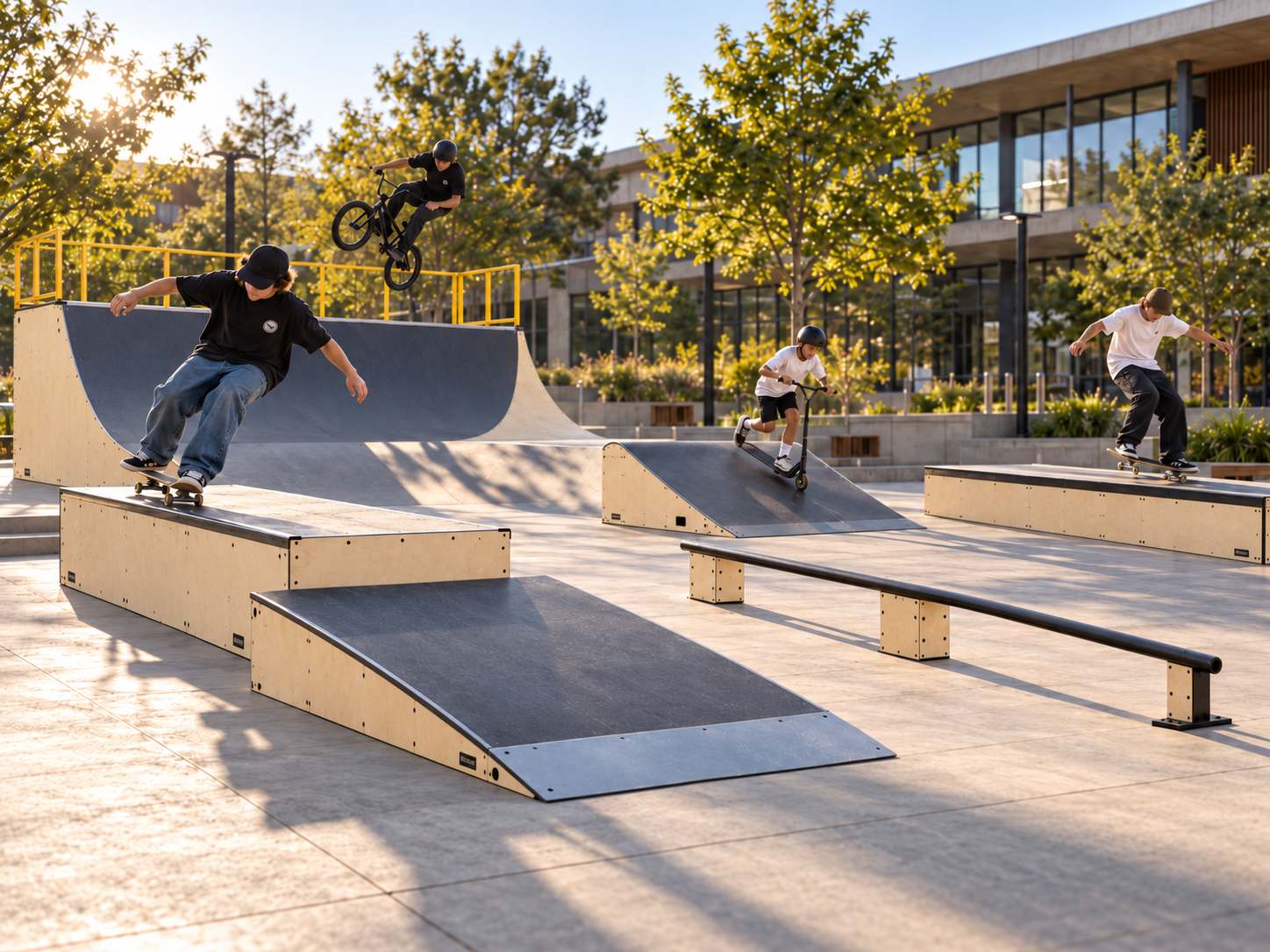
Modular systems can support deliberate progression by combining banks, ledges, boxes, rails, quarter pipes and transition features into a planned sequence. Concrete can create more integrated flowing geometry and complex bowls where the project brief justifies it.

The design question is what experience the facility needs to provide: beginner confidence, street progression, transition riding, flow, technical challenge or a combination. Select the delivery system after that riding brief is clear.

04

4. Repair and replacement should be considered before opening

Concrete and modular systems fail differently. Concrete can crack, chip or wear and may require specialist repair to preserve riding quality. Modular systems introduce panels, edges, fixings and structural components that need inspection and may be replaceable individually.

Replaceability can be a lifecycle advantage only when spare parts, surface panels, hardware and technical information are actually available. That is why RIDEspan treats maintenance and replacement evidence as part of supplier qualification rather than assuming every modular product is equally serviceable.

For public procurement, ask what a likely repair looks like, how quickly the affected area can be reopened and whether the owner needs specialist contractors or can replace a defined component.

05

5. Staged budgets can favour a modular project model

Councils, schools and developments do not always have the budget to build the final destination in one release. A modular pathway can allow an initial STREET or FLOW zone to open while space, access and services are protected for later expansion.

Staging works only when the future plan is credible. The first phase should not occupy the only logical expansion area or create drainage, path and landscape work that has to be removed later.

A useful staged brief shows phase one, the protected future zone and the trigger for phase two. That turns 'expandable' from a marketing word into a real capital-planning strategy.

06

6. Choose by project fit, then demand exact evidence

Neither modular nor concrete should win by default. Concrete may be appropriate for permanent, highly integrated skate destinations. Modular systems may be stronger where reconfiguration, staged delivery, replacement and faster project development matter.

For a modular project, the next step is not to assume every ramp is suitable for permanent public use. Confirm frame construction, riding surface, corrosion and weather protection, anchoring, structural information, maintenance, warranty, replacement components and applicable standards for the exact offered system.

That evidence-led approach is the basis of RIDEspan STREET: sell the public project outcome first, then release the exact equipment only when the technical file supports it.

  • Define the riding brief first
  • Compare total site works
  • Plan progression and circulation
  • Review repair and replacement pathways
  • Decide whether staged expansion has real value
  • Require exact technical evidence before procurement
07

7. Put procurement responsibilities into the comparison

Before inviting prices, assign responsibilities for site survey, base and drainage design, equipment engineering, installation, safety inspection and future maintenance. A modular equipment quote and a concrete construction tender cannot be compared fairly unless both include the same site boundaries and acceptance criteria.

Ask bidders to identify what is included, excluded and conditional: foundations and anchoring, delivery and unloading, ramps or riding geometry, surfacing, edge treatments, protective coatings, spare parts and the documentation needed for local approvals. Apollo offers supply-only packages, so local civil works and installation must be separately arranged.

For either option, the owner should define handover evidence, inspection procedures, defect responsibilities and the intended maintenance budget before award. That turns an attractive concept into a procurement decision that can be defended over its full operating life.

Move from intelligence to project

Apply the thinking to the actual brief.

Open RIDEspan STREET Send a project brief
Project